Wednesday, June 8, 2011

Onsen


Japanese hot spring. All these culture specific words that hold more meaning than the translation would suggest - another barrier to understanding. In this case, my parents can't realize that when we're asking to book a stay at an onsen, we're not asking to book at a hot spring - we're asking to book at the experience of the traditional Japanese meal + lodgings + open-air hot spring. But language doesn't convey that because of the lack of words to describe the transition succinctly.

Language pt III

Both of my language-related anecdotes reflect the importance of cultivating strong initial impressions - being completely unable to speak the language of a country of visitation is bad. I think it's important to be able to surpass that initial barrier between cultures - when trying to immerse yourself in another country, you are limiting yourself if you cannot at least navigate the language because you are relegating yourself only to the places that accommodate English otherwise. The sites we went to to book lodgings had ratings for the English-speaking abilities of the owners/staff - only in two cities will we have employees that can speak anything more than basic English. My friend insists that he can speak basic Japanese passably, but... we'll see. 

On one hand, I really should learn some Japanese for this trip. On the other hand, it's quite a bit of effort to learn another language and I'm proved rather inept at the whole language business. And I'm weird so I don't like understanding lyrics -I like random Latin chorals in my song because it makes the vocals part of the song if I can't understand it. If I learn Japanese, I'll understand the slew of Japanese songs I have. Decisions, decisions.

Language pt II

Continuing where my last post left off, I think it's important to know the language to avoid being branded as tourists by EVERYONE when in other countries. It's fine being a tourist when at obvious tourist attractions, but being clearly a foreigner lends itself to clearly differential treatment - and it never helps when you ask random passerbys in your native language for help.

An example I have of this is when I was in China during the summer with a friend (who, despite being Chinese, stood out like a sore thumb because of his build and dress and his consistent speaking of English due to his lack of Chinese-speaking abilities) and were looking for a place to eat near his hotel complex. A restaurant employee outside mistook us for easy pickings and tried to beckon us inside a rather dingy looking restaurant with poor English, saying stuff like "We are super cheap noodles, filling good!" because we were talking about finding a good noodle place in English. In which I then switched to Chinese and said, "This is a dumpling restaurant." We ended up walking across the street to the noodle restaurant where we had pretty nice noodle soup. 

Language

I find it rather fitting that we talk a lot about how language is one of the greatest barriers to communication.

Because I don't know Japanese. Or Chinese. Or French. Or any language other than English. Which I have a questionable grasp on. But it'll be really interesting - because through my experiences, you don't really realize how much of an impression just speaking a language does for you.

An example is this. Last summer, I was in China and was volunteering at a community center. Despite my extreme deficit in Chinese-speaking abilities and especially that of the Shanghai dialect, I spoke very basic Chinese to everyone and then whenever I was lost to what they were saying, just replied with affirmatives. As only the staff knew at first that I was American, when the children/elders I first spoke with heard me speak English, they thought that I took extensive English lessons. They were surprised to learn that English is my primary language, despite the fact that I didn't speak anything other than basic Chinese. Afterwards, the children asked me to speak in English more and I was asked to teach an English class.

But it just shows how much that initial prejudice can form the strong basis of conversations. Once they found out that my Chinese was in fact, terrible and I wasn't just being quiet because I was shy, the elders encouraged me to learn more Chinese and such. Conversations steered away from them and their experiences with their children/grandchildren to why I should learn English whenever I talked with them.

Lodgings

So I think the biggest hurdle to this trip so far is the problem of lodgings. Normally, this wouldn't be a problem. But one of the big problems is that most hotel-booking sites that my friend and I are familiar with are mostly geared for the typical Western-style hotel.

Yes, expedia has completely failed me for this trip. Yes, all the sites that my parents typically use to book places are rather useless. No, mother, we're NOT going to use priceline's bid-to-book thing that lets you book in random districts in Tokyo, because we're going to end up in some dingy western-style hotel in a questionable part of Tokyo if you shoot for anything under $60 a night. And no, what the heck, there's no way we'll find $30/night lodgings for two at any 3/4-star hotel in TOKYO.

Conveying the point that we wanted to stay in traditional Japanese lodgings for the trip was surprisingly difficult and in the end, we only got two ryokans booked while booking several western-style hostels due to cost. This is probably also because we're booking from mostly western sites because god knows we don't know any Japanese ourselves. It's a bit frustrating - there's no point of going to Japan if we're just going to try to stay as western as possible now is there, unless we get a severe case of culture shock in which case I feel like it would be triggered by familiar western-style lodgings every night.

Departures

I have to say, this is one of the most beautiful movies I've watched in a long time. I really like the simplicity of it and how its focused on the characters and their relationships with each other - something I feel that most American movies I watch only touch superficially upon. The humor in the movie was also very well-placed in conjunction with the serious aspects of the movie.

Although I won't go into too much depths in this post due to having already completed the associated movie response homework, I really think that this was an interesting movie from a viewer's perspective. Either way, from the reactions in the movie, the subject of encoffinment seemed to be rather unknown and the profession regarded poorly by the Japanese, making the movie an interesting watch of niche culture for Japanese viewers. On the foreign aspect, the whole movie seems exotic due to the emphasis on rituals and the like.

Foreign film awards are hilarious, because genres can be anything because the only requirement is non-American. But I can see why this movie won that award, because it's really well-made.

I also have to say, the music was amazing.

Alternative Residences in Tokyo

Dilemma: Cost of staying in Tokyo is limited by budget.
Solution: Stay in manga cafe.

Literally. It's a cultural thing that I think is pretty unique to urban Japan that young people are staying at these sorts of places instead. It's actually pretty amazing that there's all this infrastructure set up - although we're going to try to cram the both of us into one of these booths and trying to actually sleep... Only doing this for two days, but I'm not exactly looking forward to the cramped sleeping positions.

I think it's interesting that I can't think of a Western example of anything similar to this. Public places that aren't hotels usually would never offer overnight stays. And interestingly enough, you can do this at karaoke places in Japan too - book a booth overnight. That's a third night. Hostels for two nights of actual sleep.  Not sure you could do that in a Western karaoke place (not that I have been to many karaoke places in the first place, but interesting note anyways).

Amazing Food


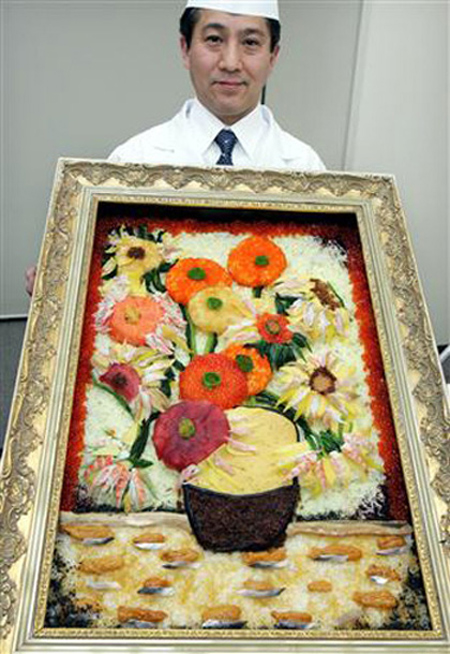
Even if I knew this all tasted like crap (which I don't), god knows I want to eat it anyways.It certainly looks delicious.

Foodstuffs

One of the first thing that has really stuck out to me during the whole planning process was the fact that every lodging we looked at had very, very nice pictures of food in their pictures. An example?


Mouthwatering, really. And this comes to the whole practice of Japanese people placing great importance in the aesthetic of food arrangement - where food has to LOOK nice being presented as well as obviously tasting amazing. I don't really think we quite have anything like this except in the higher echelons of American culture - there are the super-fancy restaurants that do things like this, but this is the norm in Japan and even the shadiest (well maybe not) restaurant will do this. All I know is that I'm abstaining from my sushi and such until I get to Japan. After all...


 you can't really eat stuff like this in the States.

Ryokans

I'm really rather annoyed that as according to budgetory issues set by my parents, I can't stay at as many ryokans that I had initially wanted to (especially since... well, suffice to say, a large part of the blame is on my parents for increased prices). What is a ryokan? Well, it looks like this.


It's a type of traditional Japanese inn along this format, where guests also sleep on tatami mats. Communal baths and public areas are present where guests are given yukatas to wear. In essence, an extremely traditional type of Japanese residency. And yukatas are traditional Japanese garments that looks like this...


I have to say though, I feel like this is the sort of experience that while nice, feels like it's being marketed out for tourism. But then again, that might just be with my limited understanding of Japanese culture outside of maybe Tokyo, where I know most people live in cramped apartment complexes. Maybe it's more common in the rural areas. Anyways, even if it is just marketed culture, it's something that I really want to at least experience, so me and my friend will be staying in one of these in Kyoto (other places, looks like just hostels in order to save money).

Shrines

I've noticed that on my itenary that I'm visiting at least 10 shrines or some such over the course of my month-long trip. It's one of those cultural things you just have to visit - google images does no justice.

Worth a whole day visit? Doesn't look like it, but images can't convey atmosphere at all from my prior experiences travelling (Mona Lisa still looks derpy when you see it in person, but less so than just an image of it, hah Grand Canyon, so on). Anyways, that is Ise Jingu, Shinto's oldest shrine in Japan. It's the first thing I'm going to visit and then its off to Kyoto, culture central where we're going to visit 10 other shrines/castles/what not.

I'm not religious, but I don't think I need to be to appreciate these shrines - apart from what's undoubtedly going to be a feeling of exotic, areas steeped in religious history always have a sensation of feeling... mystical and ethereal and stuff. Although I have to say, I've always liked more rural-type areas, so I'm the kind of guy that prefers parks over museums - meaning I'll probably end up liking these shrines more than the Vatican and whatever. Either way, I'm pumped!

Trains

You know what really annoys me? The fact that just about every country I've ever visited have efficient, working, amazing, fantastic, and fast public transportation via trains. Subways. And now, bullet trains.


Oh sure, Washington DC has trains, but really, I'd pretty much kill to be able to ride on monorails around these parts or at least have better bussing options than "oh crap I missed my come-every-30-minutes-bus."

Anyhow, from the looks of it, since I'm planning to go from Sapporo (far up north) to Hakone (near Tokyo) in one day to take advantage of my bus pass, I'll most likely be sleeping on the 22-hour train. I haven't done that in... well, ever. It'll be an interesting new experience - probably something that wouldn't happen in the states, because of how totally unreliant we are on public transportation and if my experiences on busses mean anything, totally shy away from sleeping on public transports.

First Post!

So this is the beginning of my e-portfolio. I'll be using this blog mostly just for talking about my experiences thus far planning out my trip to Japan right after graduation (I'm pumped!) but I'll probably also throw in tidbits from class discussions and whatnot.

Also, as this was originally a word document, the blog posts might be formatted a bit weird.